



Picture this. It is 10:30 PM. You have just returned from a long day at work. Your colony’s gate is backed up with cars waiting to park. Your basement ramp has a pillar that has already taken one side mirror this year. Your neighbour’s SUV is double-parked again. And your ₹80-lakh car is going to spend another night squeezed between a wall and a hatchback.
If you own a multi-storey home in Delhi- Whether it is a kothi in Vasant Vihar, a villa in DLF Gurugram, or a newly built duplex in Noida- this is not an unusual evening. It is Tuesday.
Car parking crisis in Delhi is not new. But what has changed is that homeowners now have a real, permanent solution- one that is being quietly installed in some of the capital’s finest homes. It is called a car elevator, and this blog will tell you everything you need to know about whether it is right for you.
Delhi’s Parking Problem is Personal, Not Just Political
When Delhi’s parking crisis gets discussed in newspapers, it is usually about flyovers, MCD parking lots, and traffic congestion. But for homeowners with multi-storey properties, the parking problem is far more intimate and far more expensive.
Here is what the numbers actually look like for Delhi’s premium residential areas:
73% of multi-storey homes in South Delhi report parking as their top functional challenge.
₹2–8 lakh average cost of ramp-related car damage repairs reported by Delhi homeowners over 10 years
34% rise in residential car elevator installations across Delhi NCR between 2022 and 2026 March
The core problem in most multi-storey Delhi homes is the same: the building was designed for the cars of twenty years ago. A 1998 basement was built for Maruti 800s and Ambassador sedans. Today, the same parking bay needs to accommodate a Fortuner, a Kia Carnival, or a Porsche Cayenne and the ramp that once worked perfectly now scrapes, scratches, and terrifies.
The real cost of Delhi’s parking crisis is not counted in MCD fines- it is counted in scratched bumpers, scraped alloys, cracked tails, and the daily stress of a manoeuvre that should take 30 seconds but takes 8 anxious minutes.
Why Traditional Basement Ramps are Failing Delhi’s Homeowners
Before we talk about the solution, it is worth understanding exactly why the traditional basement parking ramp- a fixture of nearly every multi-storey home built in Delhi between 1980 and 2010 is no longer fit for purpose.
The gradient problem
BIS and local building codes allowed ramp gradients of up to 1:6 (approximately 16 degrees) in residential construction. At the time, this was workable for the cars of the era. Today, low-clearance sports cars, wide-body SUVs, and luxury sedans with long wheelbases cannot negotiate a 16-degree ramp without either scraping the front lip or bottoming out entirely. The ramp has not changed. The cars have.
The width problem
The average ramp width in a Delhi kothi basement is 2.8 to 3.2 metres. A current-generation Range Rover Sport is 2.22 metres wide- before mirrors. Threading a 2.2-metre vehicle through a 2.8-metre opening, around a tight turn, under a low beam, in a basement lit by two flickering tube lights, is not parking. It is a daily obstacle course.
The humidity and structural problem
Delhi’s monsoon season turns poorly waterproofed basement ramps into slip hazards. Concrete ramps without anti-slip treatment become genuinely dangerous in July and August. And the structural load of repeated vehicle traffic- especially heavier vehicles degrades ramp edges and surface finishes faster than most homeowners anticipate.
The noise problem
For multi-storey homes where bedrooms are located above or adjacent to the basement, ramp usage creates significant noise disturbance- mostly late at night or early in the morning. A car reversing up a concrete ramp at 11 PM in a quiet Delhi colony is heard three floors up.
If your car is worth more than your ramp, it is time to reconsider the relationship between the two.
What is a Car Elevator and How Does It Solve This?
A car elevator also called an automobile elevator or car lift for home is a hydraulic or electromechanical platform system that vertically transports a vehicle between two or more levels of a building. Instead of driving onto a ramp, you drive onto a flat platform. The platform does all the work.
In a multi-storey Delhi home, this means:
- Driving your car directly onto a level platform at ground level- no ramp angle, no scraping, no manoeuvring.
- Pressing a button. The platform descends (or ascends) to the target parking level.
- Driving off the platform and into your parking space on a flat, level floor.
- The entire process takes under 90 seconds.
The platform is custom-sized to your vehicle and your available shaft space. Standard residential installations accommodate vehicles up to 5,000 kg- meaning everything from a compact hatchback to a full-size luxury SUV or performance car.
Types of car elevators used in Delhi homes
- Hydraulic car elevator: uses a hydraulic ram to raise and lower the platform. Extremely smooth, near-silent, and the most common choice for residential installations up to 4 floors.
- Electromechanical car elevator: uses a motor and chain/belt drive system. Suitable for higher travel distances and faster speeds.
- Scissor lift platform: compact, low-pit-depth option for homes where shaft depth is constrained. Works well for basement-to-ground level applications.
Attico Elevators designs and installs all three types across Delhi NCR and will recommend the right system based on your specific home layout, vehicle weight, and available shaft space during a free site assessment.
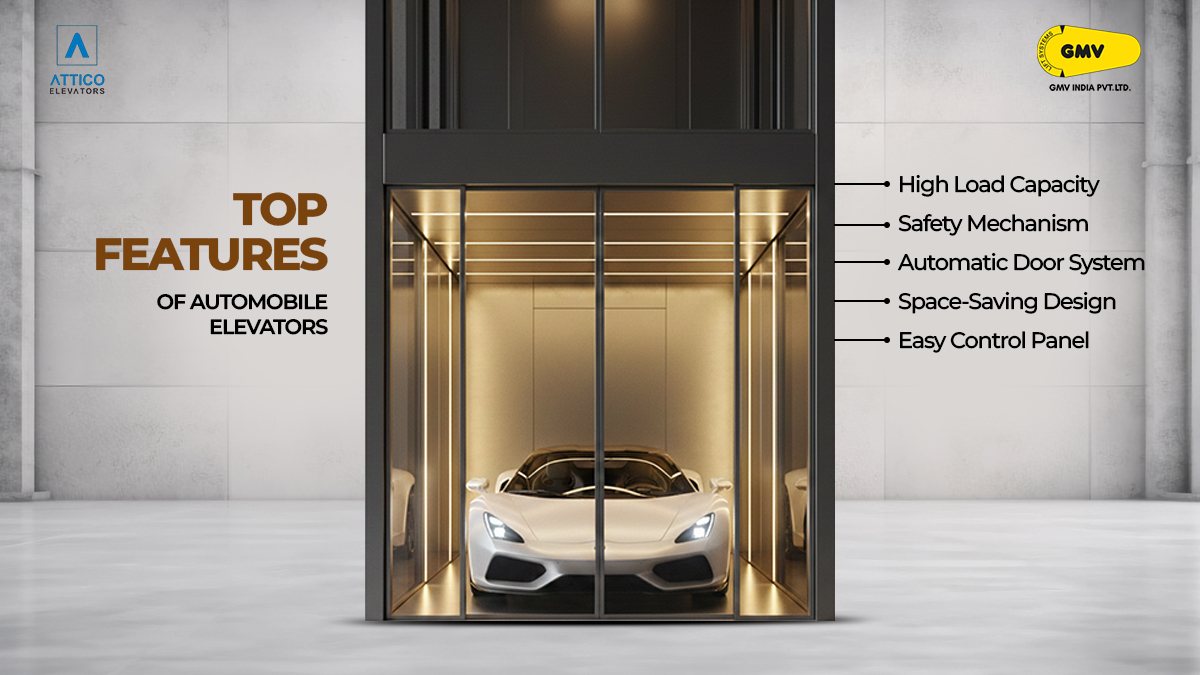
Find Here: Must-Have Features of Automobile Elevator
Car Elevator vs. Ramp vs. Turntable: Honest Comparison
Before investing in any parking solution, here is a clear comparison of the three main options available to Delhi homeowners:
| Factor | Basement Ramp | Turntable | Car Elevator |
| Scrape/scratch risk | High | Medium | None |
| Space required | Large footprint | Large footprint | Minimal shaft |
| Works for low cars | No | Partial | Yes |
| Works for wide SUVs | Difficult | Difficult | Yes |
| Night-time noise | High | Medium | Near-silent |
| Monsoon safety | Slippery | Slippery | Fully enclosed |
| Installation time | Structural work | 3–5 days | 5–8 days |
| 15-year running cost | High (repairs) | Medium | Low (AMC) |
| Property value impact | Neutral | Neutral | Increases value |
The comparison reveals what most Delhi homeowners only discover after years of ramp frustration: the car elevator is not the expensive option- it is the option that prevents ongoing expense.
Is a Car Elevator Right for Your Delhi Home?
Not every home is the same, and not every parking situation requires a car elevator. Here is an honest guide to understanding whether this solution fits your specific situation.
Your home is likely a strong candidate if:
- You have a basement parking level that vehicles access via a ramp and that ramp causes regular anxiety, scraping, or damage.
- Your home has two or more floors with separate parking levels (ground-floor garage and basement, for example).
- You own vehicles with low ground clearance, wide bodies, or long wheelbases that struggle on your current ramp.
- Your basement or garage is consistently underused because the ramp makes access too difficult or stressful.
- You own multiple high-value vehicles that deserve better protection than an open basement ramp offers.
The minimum space requirements:
- Shaft footprint: 3.0m × 5.5m to 3.5m × 6.5m depending on the vehicle class.
- Pit depth: 300mm to 600mm below the lower floor level (less than most existing basement floors already have).
- Overhead clearance: depends on vehicle height- generally 2.4m to 3.0m minimum at the upper level.
Many Delhi homeowners assume their existing space cannot accommodate a car elevator and are surprised to find that it can. A free site assessment by Attico’s engineers takes 45 minutes and gives you a definitive answer.
Looking to Explore More? Find Here: All Elevator Products by Attico
Answers to the Questions Delhi Homeowners Ask Most
Q: How much does a car elevator cost in Delhi?
A: Residential car elevators in Delhi NCR are priced between ₹12 lakh and ₹35 lakh depending on platform size, load capacity, travel distance, and finishing specifications. This is a one-time investment with a 15–25 year lifespan. When amortised over the vehicle repair costs, insurance excess, and stress of ramp-related incidents, the economics are often significantly better than they initially appear. Attico provides a detailed written quote after a free site survey- no surprises, no hidden costs.
Q: What happens during a power cut- will my car be stuck?
A: All Attico car elevator installations include a battery backup system as standard. In the event of a power failure, the platform automatically descends to ground level and allows the vehicle to be driven off. Your car will never be stranded mid-level. The backup battery is recharged automatically when power is restored.
Q: How long does installation take- will my house be a construction site for weeks?
A: Once civil preparation is complete (pit, shaft walls, electrical supply), the mechanical installation of an Attico car elevator takes 5 to 8 working days. Civil preparation varies by property in homes with existing basements, this is often minimal. Our project coordinator will give you a detailed timeline after the site survey.
Q: Can it handle my SUV- we have a Fortuner and a Cayenne?
A: Yes. Attico’s standard residential car elevator platform handles vehicles up to 3,000 kg comfortably. The Fortuner weighs approximately 2,060 kg and the Porsche Cayenne approximately 2,200 kg- both well within standard capacity. For households with commercial vehicles or heavier luxury cars, platforms up to 5,000 kg are available. Vehicle dimensions (width and length) are equally important- both the above vehicles are accommodated on a standard 3.0m × 5.5m platform.
Q: Will it require ongoing maintenance and what does that cost?
A: Like any mechanical system, a car elevator requires scheduled maintenance- twice yearly. Attico’s Annual Maintenance Contract (AMC) covers all scheduled service visits, safety inspections, and minor adjustments for a fixed annual fee. This is significantly lower than the average annual repair and touch-up cost on a vehicle subject to regular ramp incidents. Emergency response under the AMC is available 24/7.
Q: Does it add value to my property?
A: Yes, measurably. Property consultants across South Delhi and Gurugram report that multi-storey homes with car elevators command a 4–9% price premium over comparable properties without. For buyers of high-end properties- particularly those who own luxury vehicles- the presence of a car elevator is increasingly a selection criterion, not just a bonus feature.
Why Delhi’s Best Homes Choose Attico Elevators
Attico Elevators has been designing and installing residential and commercial elevator systems across Delhi NCR for over a decade. Our car elevator installations span some of the most architecturally demanding homes in South Delhi, Gurugram, Noida, and Faridabad including properties where no other company was willing to take on the complexity.
- Free site assessment by a qualified structural engineer- not a salesperson.
- Written installation timeline shared with your civil contractor before any commitment.
- All systems include battery backup, anti-slip platform surface, and safety interlocks as standard.
- Platform finishes customisable to match your garage’s interior- from industrial steel to polished concrete.
- 24/7 emergency service line throughout Delhi NCR- including weekends and public holidays.
- AMC options from Year 1- because a car elevator should be a worry-free part of your home, not a new source of anxiety.
Over 50 car elevator installations completed across Delhi NCR. Zero unresolved service complaints in the last 24 months. That is the Attico standard. Contact Attico- Best Elevator Company in Delhi NCR for any kind of lift installation.
The Parking Crisis Ends at Your Door- Literally
Problem of parking crisis in Delhi is real, widespread, and getting worse as vehicles get larger and streets stay the same width. But for homeowners with multi-storey properties, this crisis has a solution that is already within reach.
A car elevator does not just solve the parking problem. It changes the relationship between you and your home making arrival effortless, protecting your vehicles, and adding a level of architectural sophistication that reflects the investment you have already made in the rest of your property.
If you have been putting up with a difficult ramp, a scratched bumper, or a parking bay that costs you ten minutes and ten years of life expectancy every single morning- this is the year to stop.
Book Your Free Home Assessment
Attico’s engineers will assess your home, recommend the right system for your vehicles and space, and give you a written quote at no charge and no obligation. Most assessments take under one hour.