


Home elevators have transformed multi-storey living across Delhi from South Delhi villas and DLF Gurugram penthouses to compact townhouses in Noida and Ghaziabad. As more families invest in residential lifts, one question becomes critically important: what do you do when something goes wrong?
Elevator emergencies are rare with well-maintained systems, but no mechanical system is entirely immune. A power cut, a stuck door, or a jarring noise mid-ride can be alarming- especially for children, the elderly, or first-time lift users. The difference between a frightening episode and a safe resolution is almost always preparation.
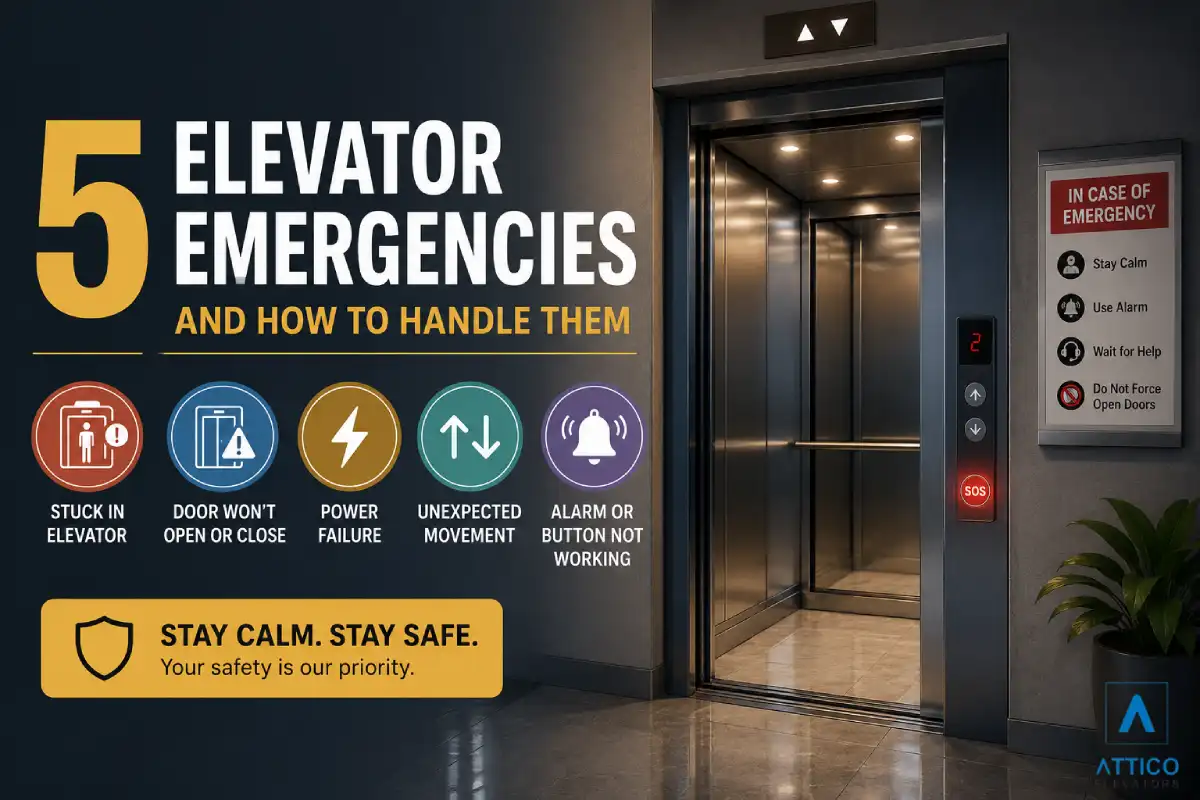
This guide covers the five most common elevator emergencies exactly how to respond to each one.
Emergency 1: Power Failure- When the Lights Go Out Mid-Ride
What Happens:
This is the most frequently reported elevator emergency in Delhi NCR, especially during the monsoon season and summer peak-demand periods when power cuts are common. The cabin lights go out, the lift stops moving, and the doors may not open.
What Your Elevator Does Automatically:
All modern home elevators including every model in Attico’s luxury lift for home range are equipped with an Automatic Rescue Device (ARD). Within 10–15 seconds of a power failure, the ARD activates, runs on battery backup, slowly moves the cabin to the nearest floor, and opens the doors automatically. You simply walk out.
WHAT TO DO:
- ✔ Stay calm and do not press multiple buttons rapidly- the ARD is already working.
- ✔ Hold the handrail if your cabin has one- the ARD descent is slow but may feel unusual.
- ✔ When doors open, exit calmly and use the staircase until power is restored.
- ✔ Call Attico to log the power failure event- even if the ARD worked perfectly.
WHAT NOT TO DO:
- ✘ Do not attempt to pry the doors open- the ARD will bring you to floor level safely.
- ✘ Do not panic or jump- the elevator is mechanically held in place and will not free-fall.
- ✘ Do not use the elevator again until a technician confirms power is stable.
Attico Tip: If your ARD has not activated within 30 seconds of a power cut, press the alarm button and use the intercom immediately.
Emergency 2: Door Malfunction- Doors Won’t Open or Won’t Close
What Happens:
Door malfunctions are the second most common elevator breakdown issue reported by Delhi homeowners. The door may refuse to close (blocking the ride), refuse to open on arrival, or reverse mid-cycle. This is often caused by an obstruction in the door track, a misaligned sensor, or during monsoon season, a swollen door frame from humidity.
Understanding Door Safety Sensors:
Every home elevator door has an infrared safety beam or mechanical safety edge. If any object- a bag strap, a pet’s tail, a child’s fingers- is in the door’s path, the sensor stops the door from closing. This is a feature, not a fault.
WHAT TO DO:
- ✔ Check visually for any object, clothing, or limb in the door track or beam path.
- ✔ Press the door-open button and check the threshold- sometimes a small item like a coin is enough to trigger the sensor.
- ✔ If the door won’t open on arrival, press the alarm button and use the intercom to call for help.
- ✔ If the door won’t close and there is no obstruction, press the door-close button once and wait 10 seconds.
WHAT NOT TO DO:
- ✘ Never force a door open manually- you could damage the door operator mechanism and create a far more expensive repair.
- ✘ Do not repeatedly hammer the button- this can confuse the door controller and lock the system.
- ✘ Never allow children to play with or hold elevator doors open repeatedly- this degrades the safety sensors over time.
Attico Tip: If doors jam repeatedly, especially post-monsoon, schedule a door alignment service. Swollen frames and misaligned tracks are the top cause of door issues in Delhi’s climate.
Emergency 3: Stuck Between Floors- The Stay-Calm Protocol
What Happens:
Being stuck in home elevator between floors is every new lift user’s biggest fear. In reality, modern home elevators have multiple independent safety systems that make this a manageable situation, but it requires you to remain calm and follow the correct protocol.
The Stay-Calm Protocol- Step by Step:
- Take a breath. The elevator is mechanically safe- it will not fall. Safety gear, guide rails, and buffers hold the cabin securely.
- Press the alarm button- the continuous bell alerts others in the building.
- Use the emergency intercom- speak clearly, state your name and which floor you are between.
- If you have mobile signal, call Attico’s 24/7 emergency helpline immediately.
- Sit down on the floor if the wait is longer- conserve energy and reduce anxiety.
- Wait for trained technicians. Do not attempt to escape through the roof hatch or force doors.
WHAT NOT TO DO:
- ✘ Do not attempt to open the doors manually to step out between floors- the gap between the cabin and landing can cause a serious fall.
- ✘ Do not try to exit through the emergency roof hatch unless instructed by a trained professional on the intercom.
- ✘ Do not allow panic to escalate- shout, scream, or bang walls. This frightens children and elderly passengers and achieves nothing.
- ✘ Do not rock or jump in the cabin- this can interfere with safety gear re-engagement.
Attico’s certified rescue team carries specialised tools for manual cabin release and can reach most Delhi NCR locations within 45–60 minutes.
Emergency 4: Overload Alarm- Why Your Elevator is Beeping
What Happens:
Your elevator emits a continuous beep and refuses to move. This is the overload protection system at work- a mandatory safety feature on all home elevators, ensuring the cabin never carries more weight than its rated capacity. In Delhi homes, this most commonly happens during parties, moving days, or when heavy furniture is transported.
How to Respond:
- Check the cabin’s rated capacity- displayed on the cabin wall (typically 250–400 kg for residential lifts, or 4–6 persons).
- Ask one or more passengers to step out until the beeping stops.
- For heavy items like furniture, always check the weight against the rated capacity beforehand.
- Once the load is within limit, the lift will resume normal operation automatically.
WHAT NOT TO DO:
- ✘ Never override or ignore the overload alarm- it is protecting the motor, ropes, and structure from permanent damage.
- ✘ Do not attempt to ‘squeeze in’ just one more person after the alarm sounds.
- ✘ Do not use the emergency stop to silence the alarm and proceed- the overload sensor will still be triggered and you risk damaging the drive system.
Good Practice: Post the elevator’s weight and passenger capacity on the inside of the cabin door- especially useful when domestic staff or guests use the lift.
Emergency 5: Strange Noises or Jerky Movement- When to Stop Immediately
What Happens:
Your elevator produces unusual grinding, scraping, or clunking sounds, or the cabin moves in a jerky, hesitant manner instead of its usual smooth ride. This type of elevator breakdown warning should never be ignored- it is almost always a mechanical signal that requires professional attention before the problem escalates.
Common Causes in Delhi Homes:
- Worn or dry guide rail lubrication- Especially common post-monsoon when rain washes out grease.
- Rope or belt wear- Gradual fraying creates vibration and noise in traction lifts.
- Loose cabin fasteners or guide shoe wear- Causes rattling and lateral movement.
- Low hydraulic oil level- Causes hesitant, jerky movement in hydraulic home elevators.
- Motor or drive unit bearing wear- A grinding noise from above or below the cabin.
WHAT TO DO:
- ✔ Exit the elevator calmly at the next floor and do not use it again until serviced.
- ✔ Note when the noise occurs- going up, going down, starting, stopping and describe it to the technician.
- ✔ Call Attico for a priority inspection- strange noises rarely resolve themselves and almost always worsen.
WHAT NOT TO DO:
- ✘ Do not continue using the elevator hoping the noise goes away- mechanical wear accelerates rapidly once started.
- ✘ Do not assume it is ‘just the building settling- elevator noises are specific and diagnostic.
- ✘ Do not attempt self-lubrication or tightening without proper training- incorrect lubricants can damage seals.
How to Use the Emergency Communication System
Every residential elevator in Delhi must, by law, should be equipped with an emergency alarm and a two-way communication device. Here is how to use them effectively:
- Alarm Button (bell icon): Press and hold for 3 seconds to activate the continuous alarm bell audible outside the shaft.
- Emergency Intercom: Press the intercom button, wait for a tone, and speak clearly. State your name, your building address, and which floor you are between.
- GSM Auto-Dialler (available on Attico smart lifts): Automatically calls a pre-programmed number- your family member or Attico’s service centre- when the alarm is triggered.
- Mobile Phone: If you have signal, call Attico’s emergency line directly. Share your live location on WhatsApp for faster response.
Important: Test your intercom and alarm system every six months. A dead intercom battery during an emergency is entirely preventable.
When to Call Attico Emergency Service
Not every elevator situation is an emergency, but when in doubt, call. Here is a quick guide on urgency levels:
Call Immediately (Emergency Line):
- Someone is trapped in the cabin and the ARD has not activated after 30 seconds.
- You smell burning or see sparks from the machine room or control panel.
- The cabin has moved unexpectedly without a floor command.
- Loud bang or crash sound from inside the shaft.
Call Within 24 Hours (Priority Service):
- Strange noise or jerky movement- stop using and book a priority inspection.
- Door malfunction that did not self-resolve.
- ARD activated- the system worked, but the root cause (battery health, power quality) must be checked.
Schedule at Next Service Visit:
- Minor vibration that started recently and is not worsening.
- Slow door response- doors open or close slightly slower than usual.
- Lighting flicker inside the cabin.
Teaching Children Elevator Safety at Home
For families with young children in Delhi homes, the home elevator can be a source of curiosity and risk. Teach these simple lift safety rules to children from the first day:
- Never play inside or around the elevator- it is not a toy or a hiding spot.
- Always wait for the doors to fully open before entering or exiting.
- Keep fingers, feet, and bags away from the door edges at all times.
- Never jump inside the cabin- even during play.
- If the elevator stops unexpectedly, press the alarm button and wait- do not try to open the doors.
- Never get in alone if you are under 8 years old- always with an adult.
A short monthly ‘elevator safety drill’- pressing the alarm button together, practising the intercom, and reviewing the emergency contact card takes five minutes and can make a significant difference in how confidently a child responds to an elevator emergency Delhi situation. One most important thing is to always contact best lift company in Delhi NCR.
Conclusion: Prepared Families are Safe Families
A luxury lift for home is one of the finest additions to modern Delhi living, but like every powerful system, it demands respect, preparation, and a trusted service partner. The five emergencies covered in this guide account for the vast majority of elevator breakdown what to do calls Attico receives from homeowners across Delhi NCR. We provide best elevator installation in Noida, Gurugram, Faridabad and Ghaziabad etc.
The common thread across every emergency is simple: stay calm, use the built-in safety systems, and call Attico. Modern home elevators are engineered with multiple redundant safety features precisely because these situations occur and they are designed to keep you safe until help arrives.
Print the emergency contact card above. Teach your household including domestic help, elderly residents, and children, the stay-calm protocol. And ensure your elevator’s Annual Maintenance Contract is active so every safety system is tested and certified before it is ever needed.